Showing posts with label denim. Show all posts

2.01.2011

Man-Sized Jeans, ACL x Telason Denim

Big dudes rejoice: the One-man Americana Army, Michael Williams of A Continuous Lean has teamed up with Tellason to create an exclusive pair of denim for those of us who, to quote the immortal Jay-Z, "can't wear skinny jeans cause [our] knots don't fit".

Williams's explains the sizing:
The ACL Fit as it became known...has a slightly higher rise in the front, a higher rise in the back, a bit of a wider leg and runs straight from the knee to the leg opening. It is a true straight leg jean...In the true spirit of America we even made sure to run the jeans up to a size 40 — so man-sized MF’ers don’t feel left out.
Although the photos in the ACL webshop make them look enormous, I've compared the size chart to that of my beloved Epaulet Hoyts and in comparison, the ACL x Telason jeans have a more generous waist, a higher total rise by a little more than 0.5", identical thigh measurements, and about 0.75" larger leg opening. They also have a shorter inseam, between 33 and 34" depending on what size you order.

In the typical ACL fashion, everything is made in America, including the leather patch, supplied by Tanner Goods. Denim is sourced from the seemingly now standard Cone Mills. All the standard accoutrements are there too (five pocket design, button fly, etc.).
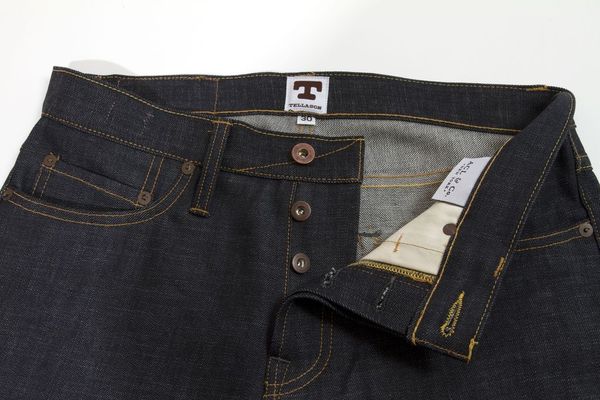
They retail for $198 in the ACL Shop (which I suppose is a bit steep for American denim but not much comes close in terms of size aside from a repro pair of LVCs).

12.10.2010

How to Shrink To Fit (STF) your Levi's

Being a vocal and ardent supporter of Levi's, particularly the rigid 501 shrink-to-fit model, I get many questions about sizing and methods for shrinkage of said jeans. So many such that I feel it necessary to create a document to point to should anyone else ask.
So here it is, the definitive TBTYH guide to STF Levi's.
What we're workin' with.
A quick disclaimer, this is my proven method for myself. You may find it doesn't work for you because of your body type/size. If you're here because your thighs/butt are big, this should work for you in general. Some of my internet friends have reported to me that they've actually had to size up in 501s to accommodate their thighs!
Before you do anything, if you've never tried on a pair of Levi's or you haven't worn a pair in many years, get to your local Sears (I'm pretty sure most carry the standard indigo rigid 501s). Try a few pairs on to get a feel for how the pre-shrink waist will fit. Levi's recommends this:
If your waist is 27"-36", Increase size by 1"
If your waist is 38"-48", Increase size by 2"
If you want your jeans to still remain fitted after the shrink-stretch cycle, I would recommend subtracting one from each of those 'size-up' numbers. In other words, get your regular Levi's size for waist sizes under 36" and one size up for sizes over 36". If you like your fit a little slouchy after you wear them in, take the Levi's advice.

For the inseam, Levi's recommends this:
If your inseam is 27"-34", Increase size by 3"
If your inseam is 36"- up, Increase size by 4"
Once again, I would alter this advice. I favor a 31.5" or 32" inseam on most of my pants. I find that a sizing up two inches on the inseam of my STFs yields the best results for me. So unless you are freakishly tall or want a crazy tall cuff, I'd say size up two in the inseam. The caveat here is that Levi's only makes even-numbered inseam lengths. You'll have to deal with that fact. I can tell you that via this method, based on actual measurements of my jeans, that are tagged and measured to be a 34" inseam will shrink about 2.5 inches to ~31.5".

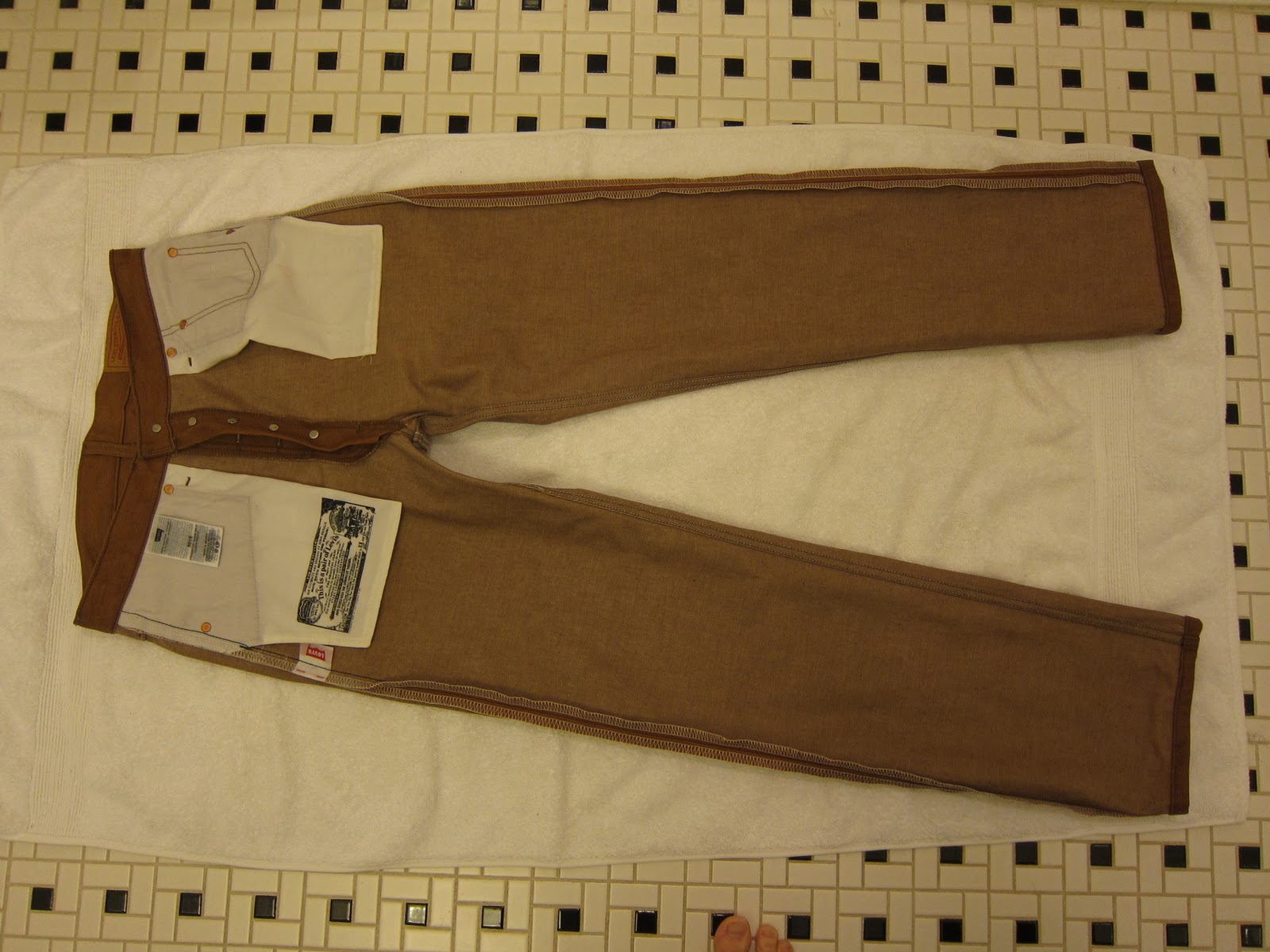
Alright, so you've figured out your size...oh great, you got a pair online in a color you like on crazy discount because Levi's has many periodic sales Now you're ready to shrink them... Aside: right now I am shedding a single tear for the "verde" greencast 501s that are now unavailable (don't worry, I haven't even started on my third and final pair). For this particular demonstration, I'm using a lighter brown pair of 501s. The procedure is the same regardless of color, however.

In order to shrink your jeans, you're going to have to expose them to water and then dry them. There is nothing magical about it, if your unsanforized denim gets wet then dries, the fabric is going to shrink, plain and simple, temperature of soaking and drying be damned. Conventional wisdom says you will get maximum shrinkage via an ultra hot soak and a hot dry. 
 
If you have a bathtub, start filling it with the hottest water your hot water heater can generate (remember to engage the stopper).

Gather your jeans and turn them inside out. This will minimize the amount of dye that leaves the fabric during the soak.
 
Next, throw them into the tub of hot water. You don't have to wait until the tub is full. As long as the jeans are fully covered in water, you can stop the flow of water and take a break. One hour is usually good enough. If this is your first soak/bath, check the tub periodically to make sure that you aren't losing water due to a leaky stopper. You don't want to come back to a pair of jeans in an empty tub.


Break time. Make yourself a sandwich, grab a beer or two, chill out for a while. After an hour or so, your jeans will be well soaked through with hot water. Fire your hand into the scalding hot tub and grab your soaking denim. Heavy, huh? Get some kind of pants hanger that can support the weight of your 501s + the water they carry. I had to wedge a washcloth in one kind of pants hanger to increase the friction in order to hold the jeans up. Hang the jeans up for twenty or so minutes to drip dry. Essentially, you want to just get rid of the serious moisture on the outside of the garment.


After the jeans are no longer dripping, lay a towel on the floor of your bathroom, place the jeans on top, then lay another towel on top of that. A drying Levi's sandwich is what you're going for here. Warning: your towels may pick up dye from the jeans. Don't worry about this, as it washes out fairly readily.

Next, imagine you are squishing grapes between your toes making wine in Italy and step on every square inch of the towel above the jeans, with both your feet, at least twice. This squeezes the extra water out of the jeans and shortens the drying cycle.
Step in the name of love. No, I'm not always wearing denim.
Rip those jeans back right-side-in and repeat the foot-blotting procedure on the exterior of the jeans.


If you're gonna wuss out, hang dry exactly like I described to drip-dry or hang on a hook from the back-most beltloop. About a day should do it depending on relative humidity. If you're planning on truly shrinking-to-fit, strip down to your skivvies, seriously. Or more. You get better heat transfer going commando. Put on your jeans! Wear them proudly while very damp. In the Northern Hemisphere, this (December) is not a very pleasant time to shrink jeans. The best time to do this is late Summer, early Fall, in my opinion. Sometimes you have no choice, however. If you get the chance to shrink in warmer weather, go outside and take a walk or bike ride. This will greatly decrease drying time.

Some tips while wearing your awesome damp Levi's:
  • Avoid sharply bending your knees. 501s have a serious tendency to stretch out in the knees, especially if you do full, ankles-below-knees squats while the jeans are wet.
  • If you're working with a darker color (especially indigo), lay towels on any upholstery you sit on. Wet denim is very prone to transfer its dye. Towels are easier to wash than your couch.
  • If you run up against your bedtime or you're just sick of wearing damp pants, hang them to dry for however long it takes. The parts that take the longest to dry are the hem, the pockets and the fly.
After the jeans are dry, the process is complete. You've done it. Start wearing the hell out of your new Levi's.
Wearing the crispy cardboard jeans for the first time.

7.01.2010

Levi's New Releases: Selvedge 201 and 501

Hot on the heels of their end-of-the-spring sale, Levi's has stocked their web site with some of the new offerings for the colder half of this year. The most compelling items in my eyes are the selvage update of the 501 and the newly re-introduced, non-LVC version of the 201. And more good news: they're both available for the very non-LVC price of $98.00.
Firstly a short history lesson: Way back in the 1870s, after hearing of miners complain of pockets ripping off of their pants in rough working conditions, Loeb (Levi) Strauss, the brains of the operation, and Jacob Davis, the money man, got a patent for using rivets to secure pockets to clothing. The American blue jean is born. The Number One overall was the first model introduced by LS&Co. This later became known as the 501 model and featured a leather patch. Shortly thereafter, a second,  budget-type model, known as the Number Two overall was introduced (later known as the 201) and featured a linen patch to differentiate it from the higher-end Number One. The primary difference between the two is that the Number Two had a lighter weight fabric than the original Number One.
Levi's has essentially offered the 501 since day one in one form or another but the 201 has seen a wax and wane phenomenon, being released maybe two times in the past ten years under Levi's LVC (Levi's Vintage Clothing) line. The current model isn't exactly faithful to the original model, featuring five pockets instead of four (the originals only had one rear pocket) but it is a nice nod to a bygone era and the history of Levi's as a brand.
In these two first photos, you can clearly see the differences between the modern 201 "Workwear Jeans" and what we've become accustomed to with the 501 and every iteration thereafter (510, 511, 514, etc.). The 201s feature a functional cinch back, suspender (aka brace) buttons and back pocket rivets. The fit appears to be even more generous than that of the 501s although I cannot confirm this fact. It isn't even apparent whether or not the selvedge denim is sanforized or not. I will inquire at Levi's HQ to find out more details. The Levi's site seems a bit reluctant to divulge details concerning the origins/quality/weight of it's denim. I would guess that the 201 is of the same weight as the 501 based upon the pictures but you never can tell for sure. The fact that the 201s are only available in a 30 or 32 inch inseam suggest that they don't shrink very much (although this is purely conjecture).
The selvedge 501s appear to be everything you've come to expect only Levi's is jumping on the 'All-Selvedge-Everything' bandwagon (which certainly makes everything better). In all seriousness though, if you are a large-thighed man, this is about the best pair of sub-100 doll-hair selvedge denim you could hope for in my (admittedly Levi's fanboy) humble opinion. Or hell, if you a regularly-sized-thigh person with a reverence for Levi's and don't mind a bit of extra fabric, these are your high-quality, raw denim heritage jeans.

As a freak of a fan of 501s, I might have to buy this pair even though I have way too much denim already. Maybe after I get a little more info on the fabric. It is already clear that they are not constructed in the U.S. ($98 price tag) and the obligatory "Imported" listed as the country of origin on the website supports this.

Hopefully more info to follow. It'd be nice if the new 501s and 201s were cut from selvedge denim from the infamous Cone Mills of North Carolina...

*Edit - Levi's has updated the site to include a few more details about these two pairs of denim. The 201's rise is 1.25" bigger than that of the 501. (12.5" vs. 11.25") and the circumference of the leg opening on the 201 is a half inch larger than on the 501. The 501s are also shrink-to-fit but the 201 is not specified as such so I have to assume that they will not shrink much (they're Sanforized). The message I got back from Levi's when I inquired originally about all the details was painfully general and didn't answer any of my questions. I'll keep pressing to see what I can find out.

5.12.2010

Epaulet Hoyt: Delivered

Well, they've arrived. If you missed it, I profiled them last week to whet your appetite and now I have the goods to evaluate. My initial impressions are very good. I've only worn them for a few hours total around the house to break them in and these jeans fit me wonderfully.
First wear, as compared to my A.P.C. Rescues, the Hoyts fit way less like jeggings and more like actually-fitting jeans. They were a bit tight at first but they've since relaxed a bit, as expected with any denim.
The difference in the weight of the fabric is quite noticeable (12.25oz. vs. 14oz. for the Rescues). They are lighter but don't give me the feeling that they're going to fall apart. Construction seems well executed and it really shows in the details: There are gunmetal rivets and donut buttons (four total buttons if you're wondering), a solid diagonal bar tack on each corners of the back pockets, and a handsome embossed leather patch above the rear right pocket (all pictured below).
I am quite satisfied with the fit and quality of this denim. Epaulet gets the TBTYH stamp of approval. And also, considering that they are made in the US with materials of US origin, $145 is a pretty good value.
I apologize for the quality of the fit photo. There really isn't much light in my kitchen at 8:00pm.

5.04.2010

Epaulet Hoyt: Here Comes A New Challenger!

I've talked about my challenges fitting into denim before. But that long wait has Epaulet has completed their new cut of jean, the Hoyt.  They've updated their beautiful Smith model to include more room in the seat and thighs (exactly what I need), expressly designed for men who are "into things like cycling, rowing, crossfit, etc." I'm going to do a paper comparison to the only other pair of selvage denim I own, A.P.C. Rescues (that is until my Hoyts are delivered).
Pictured on the left (A.P.C. Rescues on the right), the Hoyt is cut from a 12.25oz. natural line selvage from the Cone Mills White Oak plant in North Carolina. By comparison, the A.P.C.s feature 14oz. red line selvage denim from (I don't actually know). Both have contrast stitching, five pockets, and rivets in all the usual places. I think the kicker is that the Epaulet jeans are manufactured in the United States, whereas the A.P.C.s are manufactured in Macau, a territory of China. While this shouldn't really say much in terms of comparative quality (a debate for another time), as an American, I feel great supporting workers here in the US, both in the textile plant the denim was produced and also in the shop the full product was constructed in.

But enough of the details, what of the fit? Certainly the most important part of the modern jean should not be neglected.  Well, I can speak to the fit of the A.P.C.s, which are 'vanity sized'. This is the annoying part of buying A.P.C. denim. Maybe it has to do with the fact that they are generally unisex jeans but the general rule is to size down two to three from your normal size. For me this meant a size 30 in A.P.C. Any larger and I run the risk of the waistband stretching to an abnormal proportions. Denim is generally known to stretch out or relax after wear but it seems A.P.C. is especially known for this.  Seriously, when I first tried my Rescues on, I could not physically button the top two buttons. Now, one year later, the waistband is about one inch too big (while the thighs remain pretty tight). This is my dilemma. On paper, let's compare the A.P.C. Rescue's sizing to the Epaulet Hoyt's (which Epaulet recommends you buy true-to-size, in my case a 33):
*Total rise on the Hoyts were calculated from an average of the front and rear rise, which was specified on the product page.

As you can see, the Hoyts have a bit more room in the upper legs than the Rescues.  I am quite interested in the full extra inch in the thigh and the higher rise. We'll see how it works out when I get my hands on the EPs. Expect a full write-up with fit pics and comparison to the A.P.C.s. I know from experience that men with larger legs have very limited options when it comes to quality denim and I am happy to share my experience for the betterment of my large-thighed brethren.

2.22.2010

American Denim Showdown: Levis 501 vs. Wrangler 13MWZ

In the interest of full disclosure, I am admittedly quite biased toward the 501s because I've been wearing them for years and I am more comfortable with them.  However, I will do my best here to give the Wranglers a fair chance.
Levi's 501 Background
Unless you've been sleeping for the past 100 years, you've heard of and/or probably have seen Levi's iconic jean, the Original 501.  They've been produced in some form or another since the late 19th century.  In 1947, the 501 blew up and is probably the closest in cut and features that we have today in the modern iteration.  The 1947 501 was so ubiquitous that several companies still replicate it today (including Levi's itself through its heritage LVC line).  The quintessential five-pocket jean retains the gull wing pocket stitching and 'red tab' logo fabric that is sewn under the left side of the rightward rear pocket.  Levi's had the pocket design trademarked in 1943 (upper right) and is described thusly in documentation: "a double arcuate* and tab design shown on the shape of a pocket, as indicated by a solid line. The lining and shading shown in the drawing are features of the mark and not intended to indicate color."
(*ar·cu·ate: adj. Having the form of a bow; curved.)

 Wrangler 13MWZ Background
Born out of the need for rodeo-wear in the mid 1940's, Wrangler was another American overalls company (fast fact: the term "jeans" wasn't used until the 1960s).  Incidentally, 1947 marks the birth of the Wrangler 13MWZ "The Original Cowboy Cut Jean", which is still available today.

Truthfully, I did not know that Wrangler still manufactured rigid denim at all until last month when I read a post by Guiseppe on An Affordable Wardrobe.  He turned me on to Wrangler and I had to see for myself.  I ordered a pair of 13MWZs from Sheplers.  No offense to any certifiable cowboys that read this but the pictures on Sheplers make these jeans look pretty hilarious.  The crease, the cowboy boots; its a western-wear supplier, I know.  Anyway, I got a pair. The cost was not at all prohibitive (they're on sale right now for $21.99!) Also, never fear you regularly-sized people out there who want a trimmer cut: Sheplers also stocks the Wrangler 936; from what I can tell this is the slim fit version of the 13MWZ.


Notable Similarities:
  • Both have no problem accommodating my massive thighs even after shrinking, which leads to:
  • Both are unsanforized, meaning that they will shrink significantly after being saturated with water and dried.  Generally, they will shrink about 2 inches in length and 1 inch in the waist, although they will stretch out in the waist without frequent washing.
  • The fabric of both seem very similar in weight.
  • Both have a mid-high rise.
  • Both are straight through the legs.
  • Unfortunately, both are made in Mexico.
Notable Differences:
  • The rise on the Wranglers is about an inch bigger than that of the Levi's (ref. waist size 33).  That's probably the first thing I noticed after putting them on; the rise is almost ridiculous.  After soaking and drying them, however, the rise shrunk down a bit and everything was fairly cool.  This translates to having to wear the Wranglers higher on the hips or opting to "sag" them a bit.  I pull them up higher; I think they just look better that way.
  • The 13MWZ has a zipper fly, the 501 has a button fly.
  • The texture of the Wranglers feels rougher in that it seems as though the material was woven with a thicker thread.
  • The rear pockets on the Wranglers are placed about one inch higher that that of the Levi's.  According to Wrangler, this is so when rodeo dudes saddle up, they don't have to sit on their wallets.
  • Likely due to the higher rise, the 13MWZs have more room in the seat than the 501s.  Since they are straight cut, this also translates to a more roomy lower leg and leg opening.
  • The Wranglers have riveted rear pockets.  The Levi's just have rivets on the front two pockets and the coin pocket.
  • The fifth pocket (coin pocket) on the Wranglers is wider and positioned higher on the waist as compared to the Levi's.  For me, it is much harder to reach into the Wrangler coin pocket than it is for the Levi's.
  • 501s are currently available in five colors in their rigid, shrink-to-fit form: indigo, black, green, light blue, and gray.  The 13MWZs are available only available in indigo in rigid form.  If you're willing to buy a pre-washed pair, there are a bunch of colors available.
  • The Wranglers retail for $25 and the Levi's retail for about $50 (however, they frequently go on sale and can be easily had for less than $40.
A few notes on the pictures:
The 501s are of the green variety and not the standard indigo.  They've been worn for about seven months.  The Wranglers are nearly brand new: worn about four times.  The 13MWZs come with a brown rubber patch sewn into the top of the right rear pocket.  I really didn't like the way it looked so I removed it.  I think the back of the pants look way cleaner without it.

Conclusions:
Well I've given you most of the facts.  The choice is yours.  Get one or the other (or both like me).

Bonus: Supreme badass, Harrison Ford wearing 13WMZs in his most recent movie Extraordinary Measures.

2.13.2010

Denim: One of my favorite topics

This is my lower half clad in A.P.C. Rescues.  The Rescue is A.P.C.'s largest cut of selvedge denim.  As you can see, the fit in the thighs is quite tight (and this is well after the well-known "APC stretch" over the first week or so of wear).

Perhaps this gives you some perspective on exactly what I'm dealing with.  I seriously could not even consider putting on a pair of New Standards or New Cures (/shudder).

There have been several indications that even the Rescues are too small for me.  Since A.P.C. is vanity sized, I sized down three sizes (I usually wear a size 33 or 34 and I went with a 30).  The waist ended up stretching out quite a bit and I would now estimate it at 34.  However, the thighs are still very tight.

This past summer, while getting down on the dance floor at a local party, I ended up blowing out my right leg's outside seam.  About eight inches of seam just tore because of the pressure contained within.  I easily repaired the jeans.  My pride however; not so much.  Anyway, the search is still on for a better-fitting, high-quality raw denim option for my giant thighs/butt.

Before the A.P.C.s though, my love affair with dry denim was born with the classic Levis 501.  To the right is my first pair, pretty worn in (R.I.P.). In the world of Levi's, the 501 is the largest cut that can still be considered straight fit and not "relaxed".  A very popular, more tapered cut that Levi's offers is the 514.  I once tried a pair of these on at a Levi's store: no dice.  The 501 is my jam.

I actually have three pairs of 501s in my wardrobe right now: two pairs of greencasts (one newer, one older) and a black pair.  The relatively large rise of the 501s better jive with my lower body and naturally, these have become my standard bang-around jeans.  My only issue with them is that they have a propensity for unattractive stretching of the knees, yielding what is known colloquially in the denim community as knee bags.
Whether it was shear joy at how beautiful they were or just an impulse, I recently bought a pair of Epaulet's Smith jean (pictured left).  I think I was mainly drawn to them because they're made with 14oz selvedge from the Cone Mills White Oak plant in North Carolina.  The production of this fabric was discontinued eight years ago and all that was made is all there ever will be.

In my excitement, I seemed to have misread the measurements on the site.  They were awesome but I had to return them because they were too small.  Good news came out of this gaffe, however; Mike from Epaulet informed me that they were working on a cut that was designed for dudes with bigger thighs.  I'm excited to see if they'll fit me and I would definitely consider buying them if they did.  We'll see.